Civil engineers and land management professionals facing slope instability challenges increasingly evaluate geocell for slope stabilization as a robust solution capable of addressing conditions that simpler stabilization methods often can’t adequately manage.
Understanding the Stabilization Challenge
Unstable slopes present ongoing risk of soil movement, whether through gradual erosion or more sudden slippage events, particularly on grades where gravitational forces combined with water saturation can overwhelm the natural cohesion holding soil in place without additional reinforcement.
How Geocell Systems Provide Structural Reinforcement
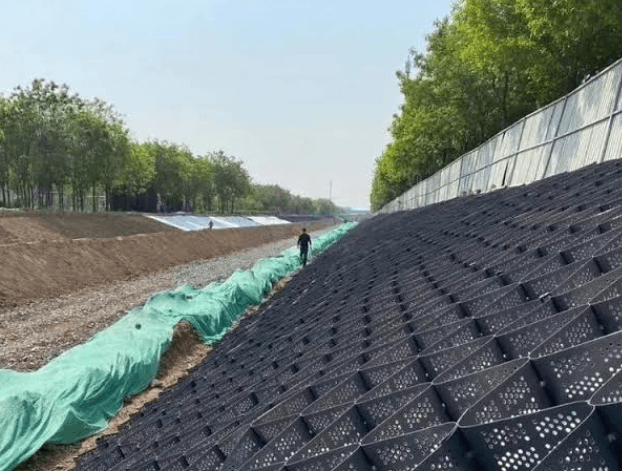
Geocell for slope stabilization works by creating a confined, cellular structure that physically reinforces the soil mass, distributing forces more effectively across the entire system rather than allowing concentrated stress points that could otherwise initiate slope failure in unreinforced conditions.
Site Assessment Before Implementation
Successful stabilization projects begin with thorough site assessment, understanding soil composition, slope grade, water flow patterns, and any existing instability indicators, ensuring the geocell system design genuinely addresses your specific site’s particular stabilization challenges.
Comparing Stabilization Approaches
While geocells offer robust stabilization for many challenging conditions, understanding how they compare to alternative approaches, including retaining structures or alternative reinforcement methods, helps ensure you’re selecting the genuinely appropriate solution for your specific site conditions and stabilization requirements.
Integration With Vegetation for Long-Term Stability
Many successful slope stabilization projects combine geocell structural reinforcement with vegetation establishment, recognizing that root systems developing over time contribute additional long-term stability beyond what the geocell structure alone provides immediately after installation.
Professionals researching stabilization solutions can find detailed technical guidance through this resource on geocell for slope stabilization applications and implementation considerations.
Installation Quality as a Critical Success Factor
Even well-designed geocell systems underperform without proper installation, including appropriate ground preparation, correct anchoring technique, and suitable fill material selection matched to the specific stabilization goals your project requires.
Ongoing Monitoring for Long-Term Success
Slope stabilization projects benefit from periodic monitoring after installation, particularly following significant precipitation or seismic events, helping identify any areas where the system might need additional attention before minor issues develop into more significant stability concerns.
Final Thoughts
Geocell for slope stabilization offers genuine engineering value for challenging terrain, provided the system is thoughtfully designed based on thorough site assessment and implemented with proper installation technique suited to your specific stabilization goals.
See also: How to Turn Your Side Hustle into a Full-Time Business
Frequently Asked Questions
How does site assessment influence geocell system design?
Understanding soil composition, slope grade, and water flow patterns helps ensure the system design genuinely addresses your site’s specific stabilization challenges rather than applying a generic approach.
Is geocell stabilization suitable for all slope conditions?
While robust, it’s worth comparing against alternative approaches for your specific conditions, since some situations may call for different or complementary stabilization methods.
How soon after installation should monitoring begin?
Ongoing monitoring, particularly after significant weather events, helps catch potential issues early throughout the system’s operational life, not just immediately after installation.