Choosing the right AI model is no longer just about picking the most powerful name on the market. Today, developers, startups, agencies, and enterprise teams need models that match their real workflow. Some projects need speed. Some need deeper reasoning. Some need a model that can handle creative writing, coding, customer support, data analysis, or large-scale automation without slowing down the entire product.
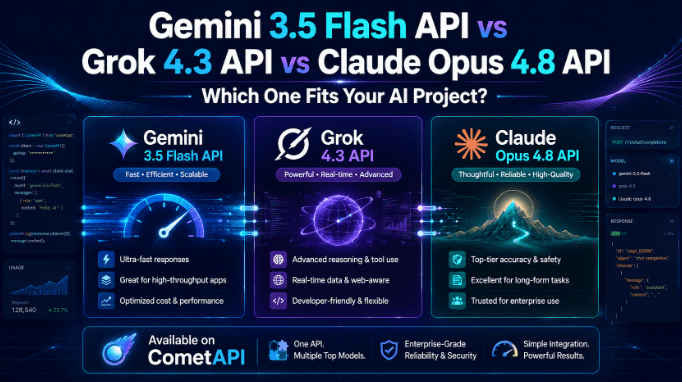
That is why the Gemini 3.5 Flash API, Grok 4.3 API, and Claude Opus 4.8 API are attracting attention from teams building modern AI products. Each model has its own strengths, and the best choice depends on your project goals, budget, response quality, and performance needs.
CometAPI, available at www.cometapi.com, gives users access to these models through a unified API platform. Instead of managing separate accounts, keys, billing systems, and integrations, developers can connect once and explore multiple advanced models from one place. Even better, CometAPI offers model usage at least 20% cheaper than official pricing, making it a practical option for teams that want strong performance without unnecessary cost.
Why Model Selection Matters for AI Projects
AI projects are becoming more specific. A chatbot for customer service does not always need the same model as a legal research assistant. A coding copilot may need different strengths from a content generation tool. A data extraction system may value speed and structure more than creative language.
Choosing the wrong model can create several problems:
- Higher usage cost than necessary
- Slow response times for users
- Inconsistent answers
- Weak performance on complex tasks
- Difficulty scaling as traffic grows
This is where comparing the Gemini 3.5 Flash API, Grok 4.3 API, and Claude Opus 4.8 API becomes useful. These models are not identical. They serve different needs, and understanding their advantages helps teams make smarter technical decisions.
Quick Comparison of the Three APIs
| Model API | Best For | Main Advantage | Ideal User |
| Gemini 3.5 Flash API | Fast responses, scalable apps, multimodal workflows | Speed and efficiency | Developers building high-volume products |
| Grok 4.3 API | Real-time style interaction, reasoning, conversational systems | Dynamic responses and strong logic | Teams building smart assistants or interactive tools |
| Claude Opus 4.8 API | Deep reasoning, writing quality, complex analysis | Careful, detailed, human-like output | Businesses needing premium quality responses |
This table gives a simple overview, but the real value comes from understanding how each model performs in practical use cases.
Gemini 3.5 Flash API: Built for Speed and Scalable Performance
The Gemini 3.5 Flash API is a strong choice for projects where speed matters. Many AI products fail not because the model is weak, but because users have to wait too long for answers. In customer support tools, productivity apps, chat assistants, and automation platforms, response time can directly affect user experience.
Gemini Flash models are generally known for efficient performance, making this API suitable for tasks that require quick output without sacrificing usefulness. It can be a good fit for apps that process many user requests throughout the day.
Common use cases include:
- AI chatbots
- Quick content generation
- Summarization tools
- Search assistants
- Workflow automation
- Multimodal app features
- Internal productivity tools
The biggest advantage of the Gemini 3.5 Flash API is balance. It is useful for teams that need a model capable enough for daily AI tasks, but fast enough to support larger usage volume. For startups and SaaS platforms, this balance can be important because every delay and every extra token cost affects growth.
Through CometAPI, developers can access the Gemini 3.5 Flash API with simplified integration and lower usage cost. Since CometAPI offers these models at least 20% cheaper than official pricing, it becomes easier to test, launch, and scale Gemini-powered features without putting too much pressure on the budget.
See also: The Future of Human-Tech Interaction
Grok 4.3 API: A Strong Option for Interactive AI Experiences
The Grok 4.3 API is useful for teams that want sharp, conversational, and reasoning-focused AI experiences. It can be a strong fit for products where users expect more than simple answers. If your project involves interactive questioning, idea exploration, logical responses, or smart assistant features, Grok 4.3 API can be worth considering.
Grok-style models are often associated with fast-moving conversational use cases. This makes them suitable for products that need personality, responsiveness, and practical reasoning in one experience.
Good project matches include:
- AI assistants
- Research helpers
- Social media tools
- Data interpretation apps
- Business analysis bots
- Coding support tools
- Interactive learning platforms
The advantage of the Grok 4.3 API is its ability to support natural back-and-forth conversations while still handling reasoning tasks. This can help make AI products feel more engaging and less robotic.
For example, a business intelligence chatbot may need to answer follow-up questions, explain trends, suggest next steps, and respond in a style that feels clear to non-technical users. Grok 4.3 API can support this type of experience when implemented properly.
CometAPI makes access easier by including Grok 4.3 API among its available model options. Developers can test it alongside other models without creating a separate setup for every provider. This is especially helpful when a team wants to compare results before deciding which model should power the final product.
Claude Opus 4.8 API: Designed for High-Quality Reasoning and Detailed Output
The Claude Opus 4.8 API is a strong option for projects that need depth, clarity, and careful language. While some models are optimized mainly for speed, Claude Opus models are often chosen for complex reasoning, polished writing, and thoughtful responses.
This makes Claude Opus 4.8 API suitable for products where answer quality matters more than simple speed. It can help with long-form writing, complex analysis, document understanding, research assistance, business planning, and technical explanation.
Best use cases include:
- Professional writing tools
- Legal and policy document review
- Research assistants
- Enterprise knowledge systems
- Complex customer support
- Strategic planning tools
- Advanced coding and debugging help
The biggest advantage of Claude Opus 4.8 API is its ability to produce refined and well-structured responses. For businesses that care about tone, accuracy, and depth, this can be a major benefit.
For example, if a company is building an AI assistant for internal reports, executive summaries, or document-heavy workflows, Claude Opus 4.8 API may provide more reliable long-form output than a model built mainly for quick responses.
CometAPI includes Claude Opus 4.8 API access on its platform, allowing users to try it with a simpler setup and more affordable pricing. Since CometAPI pricing is at least 20% cheaper than official rates, premium models become more accessible for teams that need quality but also care about cost control.
Feature-by-Feature Comparison
| Feature Area | Gemini 3.5 Flash API | Grok 4.3 API | Claude Opus 4.8 API |
| Speed | Very strong | Strong | Moderate to strong |
| Reasoning | Good | Very strong | Excellent |
| Writing quality | Good | Strong | Excellent |
| Cost efficiency | Strong | Strong | Best when quality prevents rework |
| Best project type | High-volume AI apps | Interactive assistants | Premium business workflows |
| Developer flexibility | High | High | High |
This comparison shows that there is no single winner for every project. The best model depends on what your application needs most.
If your product must respond quickly to thousands of users, Gemini 3.5 Flash API may be the better fit. If your product depends on active conversation and reasoning, Grok 4.3 API can be a smart choice. If your project needs deeper analysis and polished output, Claude Opus 4.8 API may deliver the best results.
Why Use CometAPI Instead of Separate Provider Accounts?
Many development teams start by connecting directly to one provider. That may work in the beginning, but it can become limiting as the project grows. Different AI tasks often require different models, and switching between providers can create unnecessary technical work.
CometAPI solves this by offering one unified platform for many AI models. At www.cometapi.com, users can explore the Gemini 3.5 Flash API, Grok 4.3 API, Claude Opus 4.8 API, and many other model types through one system.
The main benefits include:
- One API connection for multiple models
- Easier testing and comparison
- Lower pricing than official provider rates
- Faster development workflow
- Access to text, image, video, voice, coding, and reasoning models
- Less vendor lock-in
- Better flexibility for scaling AI products
The pricing advantage is especially important. AI usage costs can rise quickly when an application grows. Saving at least 20% compared with official pricing can make a real difference for startups, agencies, and businesses running high-volume AI workflows.
Which API Should You Choose?
The right choice depends on your project type.
Choose Gemini 3.5 Flash API if your priority is speed, scale, and efficient daily performance. It is a good option for chat apps, automation tools, summarizers, and SaaS products with frequent requests.
Choose Grok 4.3 API if your project needs interactive reasoning, conversational flow, and dynamic responses. It works well for assistants, learning tools, research bots, and business analysis features.
Choose Claude Opus 4.8 API if your product depends on thoughtful answers, high-quality writing, and complex analysis. It is a strong fit for professional tools, enterprise workflows, document-heavy tasks, and premium AI features.
In many cases, the smartest approach is not to choose only one model at first. With CometAPI, you can test all three, compare outputs, measure cost, and select the best model for each feature inside your product.
Build Smarter With More Model Choices
The Gemini 3.5 Flash API, Grok 4.3 API, and Claude Opus 4.8 API each bring different strengths to AI development. Gemini is strong for speed and scale. Grok is useful for interactive reasoning and conversational products. Claude Opus is excellent for detailed, polished, and high-quality responses.
CometAPI makes these models easier and more affordable to access through www.cometapi.com. The platform includes these models, offers pricing at least 20% cheaper than official rates, and also provides many other AI model types for developers, businesses, and creators to explore.
For any team building an AI product, flexibility matters. Instead of being limited to one provider or one model style, CometAPI gives you room to experiment, compare, and grow. Whether you are building a chatbot, automation platform, content tool, coding assistant, or enterprise AI solution, trying different models can help you find the best match for performance, quality, and cost.