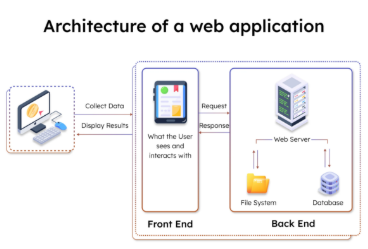
Ten years ago, the distinction between a native application and a web-based one was immediately obvious to any user. Native apps were fast, responsive, and capable. Web apps were functional but felt like a compromise — slower, less tactile, and constrained by what a browser could reasonably be asked to do. That distinction has largely collapsed. The web applications running in browsers today match or exceed the performance of native applications in most user-facing metrics, and they do so through a combination of architectural choices, browser engine advances, and infrastructure investments that have transformed what the web platform is capable of delivering.
What Modern Web Application Architecture Actually Looks Like
The Frontend Layer and Why It Has Become the Critical Path
For most of web development’s history, the server did the heavy lifting. A user requested a page, the server assembled the HTML, sent it to the browser, and the browser displayed it. The client was essentially a rendering terminal. That model had obvious advantages — it was simple, it kept logic centralised, and it required nothing from the user’s device beyond the ability to display HTML. It also had a fundamental performance ceiling: every user interaction that required new data required a round trip to the server, and every round trip introduced latency that users experienced as sluggishness.
The shift to JavaScript-heavy frontend frameworks — React, Vue, Angular, and their successors — moved the rendering and state management logic from server to client. The browser became a capable application runtime rather than a document renderer, handling component state, routing, data fetching, and DOM updates without server involvement for most interactions. The initial page load became more expensive in terms of JavaScript parsing and execution, but subsequent interactions became dramatically faster because they operated entirely within the browser’s memory without network round trips.
This architectural trade-off — expensive first load, cheap subsequent interactions — is the defining characteristic of modern single-page applications. It explains why heavily interactive web applications almost universally choose this approach, and why static or infrequently updated content sites often do not. The break-even point, where the interaction density of an application justifies the first-load cost of a JavaScript-heavy frontend, sits somewhere around three to five user interactions per session for most application categories.
Interactive entertainment platforms sit well above that threshold. A game catalogue with filtering, sorting, search, and real-time availability data generates dozens of client-side interactions per session without the user consciously registering most of them. The technical implementation of a desi casino slot catalogue is a useful reference point here: the game grid loads lazily as the user scrolls, filter state updates without page reloads, individual game previews render in modal overlays that preserve the catalogue position underneath, and the entire experience maintains smooth 60fps animation on mid-range mobile hardware. None of that is achievable with a server-rendered architecture at the interaction speeds users expect — it requires a frontend framework managing local state, a well-tuned asset delivery pipeline, and game assets served from a CDN edge node close to the user’s geographic location. The technical requirements of delivering that experience at scale are not trivial, and the architectural decisions that make it possible have been refined over years of iteration on user behaviour data.
The Backend Layer and the Shift Toward API-First Design
The server-side architecture of modern web applications has undergone an equally significant transformation over the same period. Monolithic server-side applications — where routing, business logic, data access, and template rendering all lived in a single codebase deployed as a single unit — have been progressively replaced by service-oriented and microservice architectures, typically exposing their functionality through REST or GraphQL APIs consumed by the frontend.
The primary driver of this shift was not technical elegance but operational flexibility. A monolith that serves a web frontend, a mobile app, and a third-party integration from the same codebase is a deployment bottleneck — any change to any part of the system requires deploying the entire application. An API-first backend can serve all three clients simultaneously from the same endpoints, allows individual services to be scaled independently based on their specific load profiles, and enables frontend teams to work without being blocked by backend development cycles.
The database layer within this architecture has also diversified considerably. Relational databases remain the primary store for transactional data where consistency and ACID compliance are non-negotiable — financial transactions, user account records, audit logs. Document databases like MongoDB handle flexible schema data where structure evolves rapidly. In-memory stores like Redis serve as caching layers for frequently accessed data that would be expensive to recompute on every request. Time-series databases manage the high-volume event streams that real-time analytics require. A production web application of any complexity typically uses several of these simultaneously, with each database type selected for the specific access pattern of the data it stores.
The Infrastructure That Makes It All Work
CDN Architecture and Edge Computing
The performance improvements that users have experienced in web applications over the past five years are attributable as much to infrastructure advances as to application architecture improvements. Content delivery networks have expanded from serving static assets — images, CSS, JavaScript bundles — to executing application logic at edge nodes geographically close to the user. This edge computing model reduces the physical distance that data must travel to serve a request, which reduces latency in ways that no amount of application optimisation can compensate for if the server is on the wrong continent.
For applications serving users across geographically dispersed markets — a common situation for any platform targeting users in South Asia, where the distance from a European or North American origin server to an end user in Mumbai or Dhaka introduces latency that is physics rather than engineering — edge delivery is not a performance optimisation but a baseline requirement. Platforms that have not invested in regional CDN coverage consistently underperform on load time metrics relative to those that have, regardless of how well their application code is written.
The infrastructure decisions that most significantly affect user-perceived performance for international web applications are:
- CDN provider coverage in the specific geographic markets being served — global CDN coverage statistics mask significant variation in edge node density by region, and a provider with excellent North American coverage may have sparse nodes in South and Southeast Asia
- Image optimisation pipeline — images account for the majority of page weight in most content-heavy web applications, and serving appropriately sized, modern-format images (WebP, AVIF) through an automated optimisation pipeline can reduce page weight by 60 to 80 percent without visible quality loss
- JavaScript bundle optimisation — code splitting, tree shaking, and lazy loading of non-critical modules reduce the amount of JavaScript that must be parsed and executed before the page becomes interactive
The numbered steps for auditing a web application’s performance architecture are as follows:
- Run a Lighthouse audit on a representative page from a simulated mobile device on a 4G connection, not from a desktop on broadband — the performance experience of the median user in most global markets is closer to the former than the latter
- Check Time to First Byte from multiple geographic locations using a tool like WebPageTest, identifying whether performance degradation is an application problem or a CDN coverage problem — the two have different solutions
- Analyse the JavaScript bundle with a tool like Webpack Bundle Analyzer, identifying large dependencies that could be lazy-loaded or replaced with lighter alternatives
- Review image delivery, confirming that images are served in modern formats, sized appropriately for the display context, and delivered from a CDN edge rather than origin
Conclusion: Architecture Is a Product Decision
The technology stack choices that go into a web application are not purely technical decisions. They are product decisions with direct consequences for user experience, operational cost, development velocity, and the platform’s ability to scale into new markets and use cases. The teams that understand this — that treat architecture as a product capability rather than a backend concern — build applications that compound in quality over time rather than accumulating the technical debt that eventually makes them impossible to maintain. The web platform’s current capabilities are genuinely remarkable, but they are only accessible to products built with the architectural foundations to take advantage of them.